When I was in school years ago, I was "drafted" into running cross-country when I really only wanted to run track. I never thought of my self as a distance runner and the experience left a very bad taste in my mouth, not to mention two decades plus of not running since.
Then two and a half years ago I made a statement at a party in October following a half-marathon, that I would run the half-marathon relay the following year. So six months later I went out and got a new pair of running shoes and some shorts and socks. With a donated shirt, I now had one full set of running clothes. Did I start running? Nope
Off to the beach near Charleston, South Carolina for two weeks in late July and early August and still no running for me. It was too hot to start running down there I commented, even though I had bold plans and packed my running gear for the trip. Back at home it was still August and still to hot to start running.
Finally in September I started running intervals, and built up a pace and distance that was so quick that I developed shin-splints and still was 3 miles shy of what I needed to run for the race the following month. I ended up taking two weeks off running before the race so my shins could heal.
I arrived in Pennsylvania for the race and needed to buy a long sleeve shirt since I only had one short sleeve shirt. Even so I felt like I would freeze before the race began. I felt good running the intervals during the race and race a healthy pace. So healthy, or unhealthy, that sometime early that afternoon, my body revolted and I was in pain for the next two days.
I ran a few times between then and December when I went out and ran in a 5 mile race in the cold of mid-December. I'd gone out and bought cold weather running gear and was prepared for the cold this time. The run felt good, but I still was in pain for a day after the race.
I didn't go running again for an entire year (even though I once again packed the running gear to try on vacation), until I ran the same 5 mile race in mid-December. I ran a slower pace and felt good afterwards. But this was not something I wanted to make a habit. On New Years Day I turned over a new leaf so to speak and went for a short run.
Running was interrupted for the next five months while we dealt with a severe winter and our dog's five month losing battle with cancer. A week after her death, I pulled out my running clothes and went for a run. I've been running 3 days a week ever since with plans to run two races this fall.
I've started out slow, running intervals and slowly building my distance. Home is full of hills so vacation in the heat of coastal South Carolina did mean a flat run where I increased my speed and distance.
Running might not be for everyone, but if you take it slow and do it for fun, not pushing yourself too hard, but also not giving up on yourself, it can mean long lasting health benefits. I don't plan to try to ever win a race, just signing up for them to give myself a goal to be prepared for a distance I want to run for fun. This is why I like the five mile and 8k races.
Over the next few days/weeks I will be posting some more about the things which I've found which have worked for me as I've decided to be more serious about running and taking care of myself while I run.
Wednesday, August 6, 2014

Sunday, June 22, 2014
Where did Mr. Collins go?
I think most of us are very familiar with the Collins glass. That tall, thin glass, taller and thinner than a highball glass, used for most "long drinks" from Iced Tea to those beverages of a more adult nature.
But what ever happened to the drink which gave its name to that glass?

The Tom Collins first appeared in drink recipe books in the 1876 edition of Jerry Thomas,' "The Bartenders Guide or How to Mix Drinks." The drink was incredibly popular in the late 19th and early 20th centuries. Originally made using a sweet style of gin called Old Tom, is was similar toa drink called a John Collins, and hence the name Tom Collins. There is also a story about a "Tom Collins" hoax which gave rise to the drinks name, but I won't go into that here. Regardless of how it got its name, the drink was very popular from the late 19th century well into the 20th century. It has even returned for a guest appearance in the PBS drama "Mr. Selfridge."
But the Tom Collins became a victim of its own popularity as bartenders, professional and amateur began to look for shortcuts. Collins mix, in bottle form or packets became a regular sight in shops, but now even finding these0 Tom Collins mixes is far from easy. Falling from popularity and new drink creations, as well as a new found love for wine, you must search high and low to even find the mix, and even bartenders sugar can be difficult to find today. (Note - Bartender's Sugar, also sometime know as Caster Sugar is super fine sugar and will mix well in drinks. Do not try to use confectioners sugar as it also has corn starch added. Use a simple syrup if you cannot find bartenders sugar)
These shortcuts, like so many shortcuts in life may make things easier, but they rarely make them better. The Tom Collins is a classic drink if made correctly which means using the correct ingredients. And they are very simple.
But what ever happened to the drink which gave its name to that glass?
The Tom Collins first appeared in drink recipe books in the 1876 edition of Jerry Thomas,' "The Bartenders Guide or How to Mix Drinks." The drink was incredibly popular in the late 19th and early 20th centuries. Originally made using a sweet style of gin called Old Tom, is was similar toa drink called a John Collins, and hence the name Tom Collins. There is also a story about a "Tom Collins" hoax which gave rise to the drinks name, but I won't go into that here. Regardless of how it got its name, the drink was very popular from the late 19th century well into the 20th century. It has even returned for a guest appearance in the PBS drama "Mr. Selfridge."
But the Tom Collins became a victim of its own popularity as bartenders, professional and amateur began to look for shortcuts. Collins mix, in bottle form or packets became a regular sight in shops, but now even finding these0 Tom Collins mixes is far from easy. Falling from popularity and new drink creations, as well as a new found love for wine, you must search high and low to even find the mix, and even bartenders sugar can be difficult to find today. (Note - Bartender's Sugar, also sometime know as Caster Sugar is super fine sugar and will mix well in drinks. Do not try to use confectioners sugar as it also has corn starch added. Use a simple syrup if you cannot find bartenders sugar)
These shortcuts, like so many shortcuts in life may make things easier, but they rarely make them better. The Tom Collins is a classic drink if made correctly which means using the correct ingredients. And they are very simple.
Juice half a lemon into a highball glass with lots of ice.
Add a teaspoon of bartenders sugar or simple syrup, more or less, a jigger of gin,
and a few ounces of club soda water. That's it! Now just sit back and enjoy the simple pleasures of a classic cocktail crafted in the days before air conditioning. A drink from a time when how you dressed, how you acted and what you ate and drank were dictated by the weather. This is one very special way to enjoy the summer. Cheers!
All Rights Reserved.
All Rights Reserved.
Wednesday, June 18, 2014
A New Gin for a New Summer...
I'll begin by starting that I am NOT someone who seeks out organic products, but simply quality products. I've never really thought much about organic foods and when I do consume them, it is generally by accident rather than design.
Recently I fell into an organic product and must say that I'm hooked, on it at least.

Juniper Green Gin is a certified organic London Dry Gin and perhaps the best gin I have had the pleasure of trying.
Juniper Green has a very short list of botanicals, including only four in its makeup: juniper, angelica root, coriander and savoury.
I've tasted Juniper Green in Gin & Tonic using both the American Schweppes Tonic Water as well as the British Schweppes Indian Tonic Water, against two other brands of gin, Tanqueray and Gordon's. Personally I prefer Juniper Green, using either of those two tonic waters, to the other gins which I tried. And while it might not be my everyday or entertaining gin, it certainly is what I will reach for when I want to enjoy a nice quality gin, especially in a gimlet or martini. Cheers!
All Rights Reserved.
Recently I fell into an organic product and must say that I'm hooked, on it at least.
Juniper Green Gin is a certified organic London Dry Gin and perhaps the best gin I have had the pleasure of trying.
It is certified organic by the Soil Association, the UK's leading membership charity campaigning for healthy, humane and sustainable food, farming and land use. Through their non-profit business Soil Association Certification, they inspect and award organic certification to farms and businesses that
meet their organic standards. Any product sold as ‘organic’ must
comply with strict rules which assure consumers they are buying
genuinely organic products that can be fully traceable back to the farm. Organic
standards cover all aspects of organic food certification including
production and packaging, animal welfare, wildlife conservation, and ban
unnecessary and harmful food additives in organic processed foods. Their standards not only meet the UK government's minimum requirements but
exceed them, especially in areas concerning the environment and animal
welfare.
Juniper Green is produced at the Thames Distillery and is the last gin fully produced and bottled in London. Truly the only London Dry Gin.
With aromas of lemon soufflé, fresh juniper, hay and dried herbs which follow through with a silky entry to a fruity medium to full body gin. It finishes with a long, dried citrus peel and quartzy mineral fade. This is a well crafted and balanced gin almost light and elegant. But no mistake about this gin, this is not for those who do not like the flavor of juniper.
Juniper Green has a very short list of botanicals, including only four in its makeup: juniper, angelica root, coriander and savoury.
I've tasted Juniper Green in Gin & Tonic using both the American Schweppes Tonic Water as well as the British Schweppes Indian Tonic Water, against two other brands of gin, Tanqueray and Gordon's. Personally I prefer Juniper Green, using either of those two tonic waters, to the other gins which I tried. And while it might not be my everyday or entertaining gin, it certainly is what I will reach for when I want to enjoy a nice quality gin, especially in a gimlet or martini. Cheers!
All Rights Reserved.
Tuesday, June 17, 2014
In Love With the Old Widow... Veuve Clicquot
For those who enjoy Champagne, I think each of us has our favorite, and if not a favorite label, we have a favorite style. Like all foods and beverages, we also have our own preferences for taste and flavor. Thankfully there is a wide variety of choices from which we can choose.
For me the first style of champagne I look for is Brut Champagne. Brut is the second driest style of Champagne, with Extra Brut being the driest. Don't let the term Extra Dry fool you. Extra Dry is slightly less dry that Brut, despite what you might think reading the name.
My next step is to select the brand of Brut Champagne I wish to buy. For the past 20 years, that choice has been simple. Veuve Clicquot.

In 1772, Philippe Clicquot-Muiron established the original winery which, in time, would become Veuve Clicquot. In 1775, it was first Champagne house to produce a rosé Champagne, using the method of adding red wine during production. Philippe's son, François Clicquot, married Barbe-Nicole Ponsardin in 1798, but died in 1805, leaving his widow in control of a company involved in banking, wool trading, and Champagne production. Veuve is the French word for widow. Madam Cliquot became the first woman to take over a Champagne house. Under her guidance, the firm focused entirely on the champagne production, to great success. By the time she died in 1866 Veuve Clicquot had become both a substantial Champagne house and a respected brand.
Easily recognized by its distinctive bright yellow labels, the wine holds a royal warrant from Queen Elizabeth. And since 1987 the Veuve Clicquot company has been part of the Louis Vuitton Moët Hennessy group of luxury brands, where its distinctive yellow label can be seen at various social events worldwide.
Veuve Clicquot is a yeasty style of champagne and is tightly knit, focused by racy acidity and a streak of minerals. It offers subtle notes of white peach, anise, biscuit and kumquat with a refined finish.
Champagne might not be for everyone, but if you enjoy a yeasty style of champagne, this is definitely one which you should try if you have not already done so. Cheers!
All Rights Reserved.
For me the first style of champagne I look for is Brut Champagne. Brut is the second driest style of Champagne, with Extra Brut being the driest. Don't let the term Extra Dry fool you. Extra Dry is slightly less dry that Brut, despite what you might think reading the name.
My next step is to select the brand of Brut Champagne I wish to buy. For the past 20 years, that choice has been simple. Veuve Clicquot.
In 1772, Philippe Clicquot-Muiron established the original winery which, in time, would become Veuve Clicquot. In 1775, it was first Champagne house to produce a rosé Champagne, using the method of adding red wine during production. Philippe's son, François Clicquot, married Barbe-Nicole Ponsardin in 1798, but died in 1805, leaving his widow in control of a company involved in banking, wool trading, and Champagne production. Veuve is the French word for widow. Madam Cliquot became the first woman to take over a Champagne house. Under her guidance, the firm focused entirely on the champagne production, to great success. By the time she died in 1866 Veuve Clicquot had become both a substantial Champagne house and a respected brand.
Easily recognized by its distinctive bright yellow labels, the wine holds a royal warrant from Queen Elizabeth. And since 1987 the Veuve Clicquot company has been part of the Louis Vuitton Moët Hennessy group of luxury brands, where its distinctive yellow label can be seen at various social events worldwide.
Veuve Clicquot is a yeasty style of champagne and is tightly knit, focused by racy acidity and a streak of minerals. It offers subtle notes of white peach, anise, biscuit and kumquat with a refined finish.
Champagne might not be for everyone, but if you enjoy a yeasty style of champagne, this is definitely one which you should try if you have not already done so. Cheers!
All Rights Reserved.
Monday, June 16, 2014
When The King came to America...
Seventy-five years ago, as Europe teetered on the edge of
a Second World War, a series of important meetings occurred between King
George VI of England President Franklin Roosevelt of the United States
of America. While I don't plan on going into the political aspect of the
visit, I will go into a few of the more esoteric aspect of the trip.

From May 17, 1939 until June 15, 1939, King George VI and Queen Elizabeth toured Canada, marking the first visit of a reigning monarch to visit Canada. And from June 7th to June 10th, they took a short trip into the United States as a part of that visit, marking the first visit to the United States by a reigning British monarch.
Accompanied by Canadian Prime Minister William Lyon Mackenzie King, they entered they United States at 9:05pm by train at Niagara Falls where they de-trained and were greeted by Secretary of State Hull and British Ambassador Lindsay. From here they traveled on to Buffalo over the New York Central Railroad where they arrived at 10:59pm. From there they traveled over the Pennsylvania Railroad to Harrisburg and on to Baltimore, where they changed from steam engines to the GG-1 electric engines for their trip into Washington, D.C.
There were no plans for an official visit to Baltimore, as they would only be stopped for six minutes to allow for an engine and crew change. Mrs Emma D. Price of Ten Hills in Baltimore thought that Baltimore should do something to greet Their Majesties, but was denied official permission from the State Department to do so. She then approached officials with the Pennsylvania Railroad who wired her request to York, Pennsylvania. She waited in the train shed and when the train arrived was told that The King and Queen had agreed to meet with her. she presented the American Beauty Roses to Queen Elizabeth on behalf of the Mayor of Baltimore and his wife.


With the engine and crew change complete, The King and Queen continued on to Washington where they arrived at Union Station on track 20. There President Roosevelt greeted them in the President's Waiting Room, part of the station recently occupied by B. Smith's Restaurant.


After the visit to Washington, which included a trip down the Potomac to Mount Vernon, they continued on to Red Bank, NJ, over the Pennsylvania Railroad, From here Their Majesties traveled by motor coach to Fort Hancock. Here they boarded a US Navy destroyer for their trip into New York City and the 1939 New York World's Fair.
From New York, they continued on to Hyde Park by car, eventually returning to Canada at Rouses Point by way of the New York Central Railroad and the Delaware and Hudson Railroad.

The cars of the Royal Train were decorated in royal blue with a car-length band of aluminum running across the window area. The aluminum panels were applied in diamond-shaped designs to flash more brilliantly in the sun. Above and below the windows were thin gold bands running the length of each car. The last two cars, where The King and Queen stayed, carried the royal coat of arms in the center under the windows. Each car featured a radio and telephone. The six Canadian National cars were prepared at their Point St. Charles shops. The six Canadian Pacific cars were prepared at their Angus shops. All but the last two cars of the train carried the royal cypher and crown centered below their window lines and a royal crown at each end of the blue stripe above the window line.

The two cars occupied by The King and Queen were as follows.
Canadian National Governor General's Car #1 - Open end observation car. Contained two bedroom suites for The King and Queen, a sitting room overlooking the rear platform, and two bedrooms for members of the royal staff. The car carried the royal coat of arms centered below the windows.

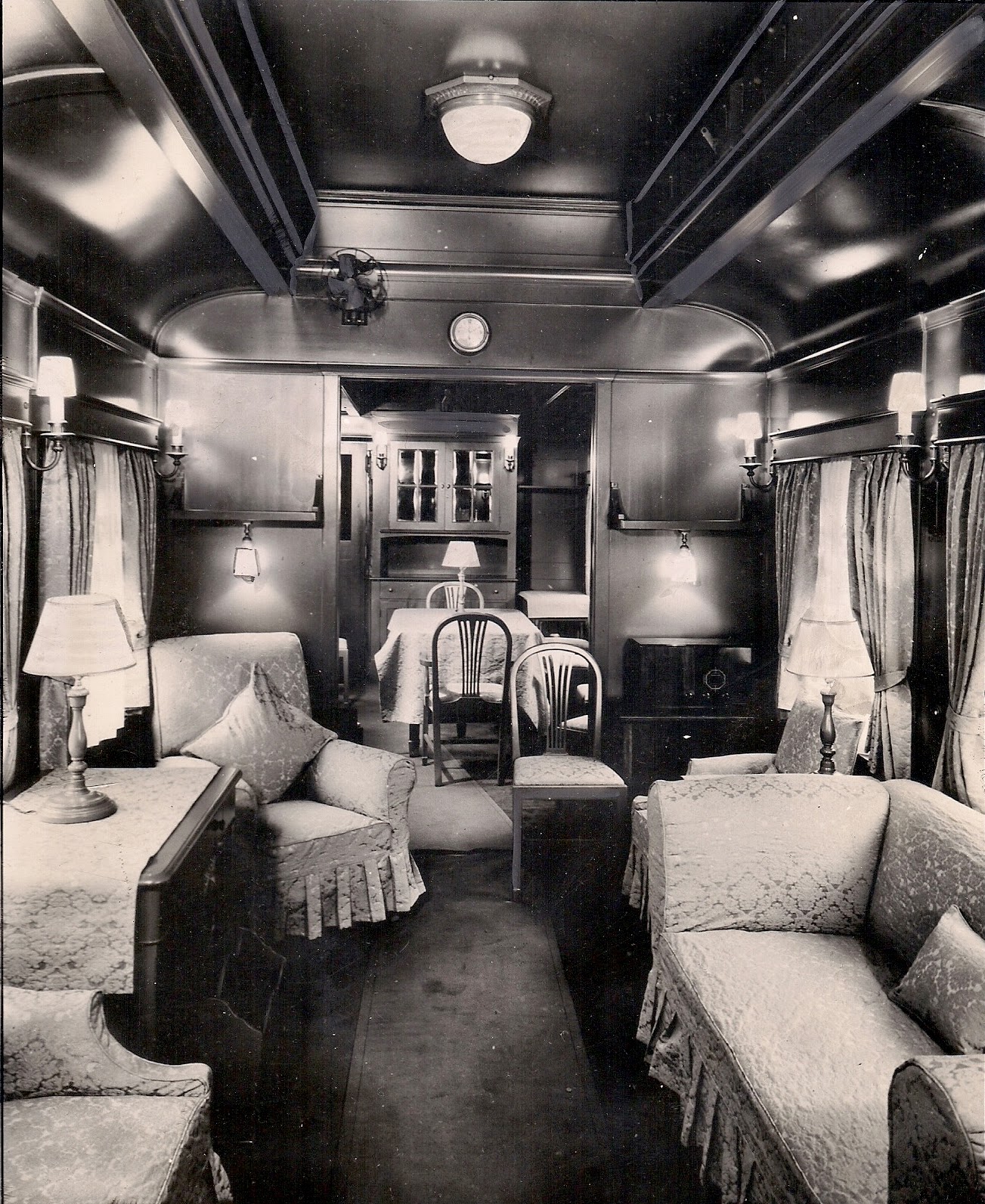
Canadian National Governor General's Car #2 - This car featured a large sitting room, and, ahead of that, a dining room with seating for 12. The car carried the royal coat of arms centered below the windows.

The follow are the remaining cars which made up the Royal Train on this visit.
Canadian Pacific End Door Baggage Car 4473 - This car contained a small Bellis & Morcom generator to supply the train with electricity, powered by steam from the locomotive. Also contained a set of six floodlights to illuminate the train and its surroundings at night.
Canadian Pacific Baggage Sleeper 4484 - This car contained refrigerated food storage and a telephone PBX switchboard to connect the train with telephone service at various stops. Also contained a steam pressing table, ironing board and storage for uniforms and linens. The car also provided sleeping quarters for some of the train's staff.
Canadian National Dining Car 1330 - This car was the latest type of dining car in service with seating for 40.
Canadian Pacific 8 Section on 4 Bedroom Sleeping Car "Viceroy" - This car provided sleeping quarters for several Canadian Mounties, plus a barber shop.
Canadian Pacific 14 Bedroom Sleeper Car "Grand Pre" - This car held the Train Office and provided sleeping accommodations for several officials.
Canadian National Business Car 99 - This car was used by the Lord-in-Waiting, John Scott, The Earl of Eldon, and the Lord Chamberlain, David Lyulph Gore Wolseley Ogilvy, The Earl of Airlie.
Canadian National 6 Compartment Lounge Car "Atlantic" 1196 - This car was used by other members of the royal party.
Canadian Pacific Private Car "Wentworth" - This car was used by the Prime Minister in attendance, William Lyon Mackenzie King, and his staff.
Canadian National 6 Compartment Lounge Car "Pacific" 1197 - This car was used by other members of the royal party.
Canadian Pacific 14 Bedroom Sleeper Car "Grand Manan" - This car provided accommodations for the personal servants of Their Majesties.
All Rights Reserved.
From May 17, 1939 until June 15, 1939, King George VI and Queen Elizabeth toured Canada, marking the first visit of a reigning monarch to visit Canada. And from June 7th to June 10th, they took a short trip into the United States as a part of that visit, marking the first visit to the United States by a reigning British monarch.
Accompanied by Canadian Prime Minister William Lyon Mackenzie King, they entered they United States at 9:05pm by train at Niagara Falls where they de-trained and were greeted by Secretary of State Hull and British Ambassador Lindsay. From here they traveled on to Buffalo over the New York Central Railroad where they arrived at 10:59pm. From there they traveled over the Pennsylvania Railroad to Harrisburg and on to Baltimore, where they changed from steam engines to the GG-1 electric engines for their trip into Washington, D.C.
There were no plans for an official visit to Baltimore, as they would only be stopped for six minutes to allow for an engine and crew change. Mrs Emma D. Price of Ten Hills in Baltimore thought that Baltimore should do something to greet Their Majesties, but was denied official permission from the State Department to do so. She then approached officials with the Pennsylvania Railroad who wired her request to York, Pennsylvania. She waited in the train shed and when the train arrived was told that The King and Queen had agreed to meet with her. she presented the American Beauty Roses to Queen Elizabeth on behalf of the Mayor of Baltimore and his wife.
Mrs Emma D. Price, of Ten Hills in Baltimore, presenting Queen Elizabeth with a bouquet of American Beauty Roses at Pennsylvania Station in Baltimore
Baltimore Sun Photo
King George VI and Queen Elizabeth on the platform of their Royal Train
at Pennsylvania Station as they prepare to depart Baltimore.
International News Photo
With the engine and crew change complete, The King and Queen continued on to Washington where they arrived at Union Station on track 20. There President Roosevelt greeted them in the President's Waiting Room, part of the station recently occupied by B. Smith's Restaurant.
King George VI and Queen Elizabeth at Track 20 in Union Station as they prepare to meet
President Roosevelt.
President Roosevelt.
AP Wire Photo
The Presidential Waiting Room in Union Station. The Walls of the room were cream, trimmed in gold and a deep green.
AP Wire Photo
President Roosevelt greets King George VI in the Presidential Waiting Room at Union Station. Left to right: Mrs Roosevelt, President Roosevelt, Brigadier General Edwin Watson, King George VI, Queen Elizabeth, and Secretary of State Hull
Wide World Photos
After the visit to Washington, which included a trip down the Potomac to Mount Vernon, they continued on to Red Bank, NJ, over the Pennsylvania Railroad, From here Their Majesties traveled by motor coach to Fort Hancock. Here they boarded a US Navy destroyer for their trip into New York City and the 1939 New York World's Fair.
From New York, they continued on to Hyde Park by car, eventually returning to Canada at Rouses Point by way of the New York Central Railroad and the Delaware and Hudson Railroad.
Route of the Royal Train in the United States of America
The cars of the Royal Train were decorated in royal blue with a car-length band of aluminum running across the window area. The aluminum panels were applied in diamond-shaped designs to flash more brilliantly in the sun. Above and below the windows were thin gold bands running the length of each car. The last two cars, where The King and Queen stayed, carried the royal coat of arms in the center under the windows. Each car featured a radio and telephone. The six Canadian National cars were prepared at their Point St. Charles shops. The six Canadian Pacific cars were prepared at their Angus shops. All but the last two cars of the train carried the royal cypher and crown centered below their window lines and a royal crown at each end of the blue stripe above the window line.
Joseph Charbonneau completing the transfer work on the Royal Coat-of-Arms
at the Canadian National Shops at Point St. Charles
Wide World Photos
The two cars occupied by The King and Queen were as follows.
Canadian National Governor General's Car #1 - Open end observation car. Contained two bedroom suites for The King and Queen, a sitting room overlooking the rear platform, and two bedrooms for members of the royal staff. The car carried the royal coat of arms centered below the windows.
The King's Bedroom
Associated Press Photo
Canadian National Governor General's Car #2 - This car featured a large sitting room, and, ahead of that, a dining room with seating for 12. The car carried the royal coat of arms centered below the windows.
Royal Sitting Room complete with Radio and Telephone
Associated Press Photo
Private Dining Room for the King and Queen seen from the Royal Sitting Room
Associate Press Photo
The follow are the remaining cars which made up the Royal Train on this visit.
Canadian Pacific End Door Baggage Car 4473 - This car contained a small Bellis & Morcom generator to supply the train with electricity, powered by steam from the locomotive. Also contained a set of six floodlights to illuminate the train and its surroundings at night.
Canadian Pacific Baggage Sleeper 4484 - This car contained refrigerated food storage and a telephone PBX switchboard to connect the train with telephone service at various stops. Also contained a steam pressing table, ironing board and storage for uniforms and linens. The car also provided sleeping quarters for some of the train's staff.
Canadian National Dining Car 1330 - This car was the latest type of dining car in service with seating for 40.
Canadian Pacific 8 Section on 4 Bedroom Sleeping Car "Viceroy" - This car provided sleeping quarters for several Canadian Mounties, plus a barber shop.
Canadian Pacific 14 Bedroom Sleeper Car "Grand Pre" - This car held the Train Office and provided sleeping accommodations for several officials.
Canadian National Business Car 99 - This car was used by the Lord-in-Waiting, John Scott, The Earl of Eldon, and the Lord Chamberlain, David Lyulph Gore Wolseley Ogilvy, The Earl of Airlie.
Canadian National 6 Compartment Lounge Car "Atlantic" 1196 - This car was used by other members of the royal party.
Canadian Pacific Private Car "Wentworth" - This car was used by the Prime Minister in attendance, William Lyon Mackenzie King, and his staff.
Canadian National 6 Compartment Lounge Car "Pacific" 1197 - This car was used by other members of the royal party.
Canadian Pacific 14 Bedroom Sleeper Car "Grand Manan" - This car provided accommodations for the personal servants of Their Majesties.
All Rights Reserved.
Monday, April 21, 2014
The Long Standing Tradition of Junior Steeplechase in Maryland...
Next weekend on the day after the Maryland Hunt Cup, the Maryland Junior Hunt Cup will be run in the same Worthington Valley as the big race, but over a course at Shawan Downs a bit further down the valley and closer to the Harrisburg Expressway.
Here in Maryland, junior racing has a very long history, beginning with the Grand National which eventually became a major race for adult riders. After the change in the Grand National, junior racing returned in 1920 with the Junior Point-to-Point for riders under 16 and was run on a course of over 2 miles.
In 1921, the Junior Point-to-Point was run over a 2 1/2 mile course at Marberne Manor Farm, estate of Mr. & Mrs. G. Bernard Fenwick in Worthington Valley with all the riders in the race between 15 and 16 years old, eventually opening to ages 18 and under by 1923. The Junior Point-to-Point continued until 1924 when it ceased to be run for a number of years.

In 1932, the Junior Cross Country Point-to-Point was renewed over a two mile course over the Worthington Valley estate of J.W.Y. Martin for riders between 15 and 20 years of age. The course, approximately two and a half miles, consisted of four fences three feet six inches high, four fences three feet ten inches high and four fences four feet high. It was a nearly circular course beginning at the 12th fence of the Hunt Cup Course and ending near the 16th fence of the Hunt Cup.

In 1933, the race was run for the Brewster Challenge Cup, donated by Mr. & Mrs. Daniel Baugh Brewster, which was to be won three times before being retired and passing into permanent possession of the winner. That year the race was listed for those riders between 15 and 21 years of age.
A large part of the social scene in those days, in 1934 the Committee for the Junior Cross Country Steeplechase put on a dance and the Elkridge Kennels.

Continuing to be an important part of the Baltimore social scene, following the race in 1937, the Committee of the Junior Cross Country Steeplechase put on a dance and the Green Spring Valley Hunt Club.
In 1938, the race was cancelled out of respect for John G. Fenwick, secretary of the event, who was killed in a plane crash.
In 1939, the race, now known as the Junior Point-to-Point with a new race committee, was reorganized and run over a course of about 5 miles from J. Walton Bolgiano's farm north of Shawan to the meadow of G. Bernard Fenwick, over 18 or 20 fences and ditches. There was no mention of the Brewster Cup being awarded at this running of the race.
In 1940, the race was run over a 3 1/2 mile course consisting of no less than 14 fences, beginning at the barrier on G. Bernard Fenwick 's estate on Tufton Avenue, up the slope and over to Frank A. Bonsal's, and continuing a zig-zag course to the finish line over the land of Tall Caples, Redmond S. Stewart, John Vanderbogart, George Abell, Albert Albright, and J. Walton Bolgiano.
As with all things, World War II caused an interruption in junior racing. It was not until 2002 that the current Maryland Junior Hunt Cup was initiated. It is a full day of junior racing from pony flats to the thoroughbred Field Master's Chase. While not the end of the season for the junior racers, it is certainly the pinnacle and a great day to spend the day watching these great riders. And every year, I am sure to see the likes of winning Hunt Cup jockey's Jamie Stierhoff or Mark Beecher cheering on these young riders with the rest of the crowd.
Quite a few names in steeplechase racing today once rode in these junior racers to include Conner Hankin, Erik Poretz and Maggie Herzog. Even Kentucky Derby hopeful Rosie Napravnik once rode in these races.
So if you are looking for something to do after the Maryland Hunt Cup, join winning Maryland Hunt Cup jockeys and support these young riders.
Results of Junior Steeplechase Winners from 1920 to 1940
1920 - Billy Barton - Mrs. Frank G. Baldwin - Stuart S. Janney, Jr.
1921 - Moccasin - Mrs. Frank A. Bonsal - Frank A. Bonsal Jr.
1922 - May Emory - Thomas Cover - Thomas Cover
1923 - Moccasin - Mrs. Frank A. Bonsal - Frank A. Bonsal, Jr.
1924 - Unknown
1925-1931 Not Run
1932 - Red Brand - Jervis Spencer, Jr. - Richard M. Janney
1933 - Baby Bunting - G. Bernard Fenwick - John G. Fenwick
1934 - Hal Dale - Mrs. S.T. Patterson - M. Nelson Bond Jr.
1935 - Myrmidon - John H. O'Donovan - Hugh J. O'Donovan
1936 - Decanter - William R. Pfefferkorn - William R. Pfefferkorn
1937 - Miss Superior - H. Norman Baetjer Jr. - H. Norman Baetjer Jr.
1938 - Not Run
1939 - Sir Greygrass - Robertson Fenwick - Robertson Fenwick
1940 - Ibn Zah - Daniel Brewster - Daniel Brewster
All Rights Reserved.
Here in Maryland, junior racing has a very long history, beginning with the Grand National which eventually became a major race for adult riders. After the change in the Grand National, junior racing returned in 1920 with the Junior Point-to-Point for riders under 16 and was run on a course of over 2 miles.
In 1921, the Junior Point-to-Point was run over a 2 1/2 mile course at Marberne Manor Farm, estate of Mr. & Mrs. G. Bernard Fenwick in Worthington Valley with all the riders in the race between 15 and 16 years old, eventually opening to ages 18 and under by 1923. The Junior Point-to-Point continued until 1924 when it ceased to be run for a number of years.
1936 Junior Cross Country Steeplechase
The winner, Decanter on the extreme left, Billy Pfefferkorn up, Center horse Walter K ridden by Cosgreve Jackson and Baby Bunting ridden by John G. Fenwick.
The winner, Decanter on the extreme left, Billy Pfefferkorn up, Center horse Walter K ridden by Cosgreve Jackson and Baby Bunting ridden by John G. Fenwick.
Photo by Baltimore Sun
In 1932, the Junior Cross Country Point-to-Point was renewed over a two mile course over the Worthington Valley estate of J.W.Y. Martin for riders between 15 and 20 years of age. The course, approximately two and a half miles, consisted of four fences three feet six inches high, four fences three feet ten inches high and four fences four feet high. It was a nearly circular course beginning at the 12th fence of the Hunt Cup Course and ending near the 16th fence of the Hunt Cup.
The Brewster Challenge Cup
In 1933, the race was run for the Brewster Challenge Cup, donated by Mr. & Mrs. Daniel Baugh Brewster, which was to be won three times before being retired and passing into permanent possession of the winner. That year the race was listed for those riders between 15 and 21 years of age.
A large part of the social scene in those days, in 1934 the Committee for the Junior Cross Country Steeplechase put on a dance and the Elkridge Kennels.

1937 Junior Cross Country Steeplechase
Believed to be Cree, ridden by Page Edmunds followed by Walter K ridden by Congreve Jackson and Hurray ridden by John Bosley Jr.
Believed to be Cree, ridden by Page Edmunds followed by Walter K ridden by Congreve Jackson and Hurray ridden by John Bosley Jr.
Photo by Baltimore Sun
Continuing to be an important part of the Baltimore social scene, following the race in 1937, the Committee of the Junior Cross Country Steeplechase put on a dance and the Green Spring Valley Hunt Club.
In 1938, the race was cancelled out of respect for John G. Fenwick, secretary of the event, who was killed in a plane crash.
In 1939, the race, now known as the Junior Point-to-Point with a new race committee, was reorganized and run over a course of about 5 miles from J. Walton Bolgiano's farm north of Shawan to the meadow of G. Bernard Fenwick, over 18 or 20 fences and ditches. There was no mention of the Brewster Cup being awarded at this running of the race.
In 1940, the race was run over a 3 1/2 mile course consisting of no less than 14 fences, beginning at the barrier on G. Bernard Fenwick 's estate on Tufton Avenue, up the slope and over to Frank A. Bonsal's, and continuing a zig-zag course to the finish line over the land of Tall Caples, Redmond S. Stewart, John Vanderbogart, George Abell, Albert Albright, and J. Walton Bolgiano.
As with all things, World War II caused an interruption in junior racing. It was not until 2002 that the current Maryland Junior Hunt Cup was initiated. It is a full day of junior racing from pony flats to the thoroughbred Field Master's Chase. While not the end of the season for the junior racers, it is certainly the pinnacle and a great day to spend the day watching these great riders. And every year, I am sure to see the likes of winning Hunt Cup jockey's Jamie Stierhoff or Mark Beecher cheering on these young riders with the rest of the crowd.
Quite a few names in steeplechase racing today once rode in these junior racers to include Conner Hankin, Erik Poretz and Maggie Herzog. Even Kentucky Derby hopeful Rosie Napravnik once rode in these races.
So if you are looking for something to do after the Maryland Hunt Cup, join winning Maryland Hunt Cup jockeys and support these young riders.
Check out the Maryland Steeplechase Association website for more information:
Results of Junior Steeplechase Winners from 1920 to 1940
1920 - Billy Barton - Mrs. Frank G. Baldwin - Stuart S. Janney, Jr.
1921 - Moccasin - Mrs. Frank A. Bonsal - Frank A. Bonsal Jr.
1922 - May Emory - Thomas Cover - Thomas Cover
1923 - Moccasin - Mrs. Frank A. Bonsal - Frank A. Bonsal, Jr.
1924 - Unknown
1925-1931 Not Run
1932 - Red Brand - Jervis Spencer, Jr. - Richard M. Janney
1933 - Baby Bunting - G. Bernard Fenwick - John G. Fenwick
1934 - Hal Dale - Mrs. S.T. Patterson - M. Nelson Bond Jr.
1935 - Myrmidon - John H. O'Donovan - Hugh J. O'Donovan
1936 - Decanter - William R. Pfefferkorn - William R. Pfefferkorn
1937 - Miss Superior - H. Norman Baetjer Jr. - H. Norman Baetjer Jr.
1938 - Not Run
1939 - Sir Greygrass - Robertson Fenwick - Robertson Fenwick
1940 - Ibn Zah - Daniel Brewster - Daniel Brewster
All Rights Reserved.
Sunday, April 20, 2014
The Greatest Test of Timber Racing...
When last Saturday in April arrives in Baltimore, the focus of a large part of Baltimore turns to the same place it has since the days of their grandparents and even great grandparents, the Worthington Valley. It's time for the Maryland Hunt Cup, a true test of a horse's and rider's endurance.
This isn't your average horse race. The horses, averaging 10-13 years old race over 22 fences, 4 board and 18 rail, ranging in height from 2'11" at the water jump to 4'10" at the number 16 fence. And that is it, one race! It is an entire afternoon spent picnicking and tailgating in anticipation of that single race. The only vendors present are selling the race program and race caps and t-shirts. There is no other commercial activity and no commercial advertising present anywhere.
How many other horse racing events are only based around one race? And how many major sporting events are still void of corporate sponsorships? I can't think of anywhere else I'd rather be on the last Saturday in April.

The Maryland Hunt Cup began in 1894 when the members of the Elkridge Hunt challenged members of Green Spring Valley Hunt to a timber race on Dr. William Lee's property near Stevenson Station in the Green Spring Valley and heading east finishing near George Brown's race track at Brooklandwood, a distance of 4 miles. The first race was limited to members of those two clubs, but the next year the race was opened to members of any fox hunt in Maryland. In 1903, members from recognized hunts throughout the United States and Canada were invited to participate.
In 1895 the race began at Hampton Gate on Dulaney Valley Road, a mile north of Towson, and ran over a circular course of about 4 1/8 miles. The following year the race returned to the Green spring Valley, starting at Brooklandwood and running a distance of a little less than 5 miles. It remained in that area one last time in 1897, starting in a field directly north of Brooklandville Station on the east side of Falls Road.
In 1898 the race moved near Cockeysville, starting and ending at Gerar, the country home of E. Gittings Merryman and the following year to “Long Green,” the country seat of W.S.G. Williams. The house at Gerar was demolished by 1962 to make way for Marriott's Hunt Valley Inn, with the remainder of the property becoming part of the Hunt Valley Industrial Park. Long Green would become part of the Deford/Boordy Vineyard Estate.
The race returned to the Green Spring Valley in 1900 and 1901 before moving to R.M. Dennison’s farm, Salona in Timonium in 1902. Then in 1903, the race started 1/4 mile north of Towson, directly east of York Road, and finishing at Hampton. In 1904, the Hunt cup returned for one last run in the Green Spring Valley, site of its birth ten years earlier, where it remained through 1914, running over a number of owners properties.
In 1915, the Hunt Cup left the Green Spring Valley for good, never to return. That year it was run for the first time in the Worthington Valley, starting and finishing at Merberne Manor Farm, the home of G. Bernard Fenwick, where it remained through 1918. Since the Fenwick Farm was entirely fenced in wire, the race committee had to build panel fences in order to run the race.
With the Fenwick Farm being planted in corn in 1919, the race moved back to Hampton in Dulaney Valley for two years before moving to Five Farms, country home of Stuart Oliver, for the 1921 race, the last race to be run outside Worthington Valley.


There are three different parking options for spectators and everyone has their favorite vantage point, from any of the 22 jumps, to the hillside overlooking the course or the final dash for the finish. If you plan things well, you can even see multiple jumps and the finish line up close.
And while this race is clearly the dressiest of all the Maryland timber races, spectators for this races, like all the races, are well advised to first dress for the weather and then to dress for fashion. To say that this is a coat and tie event is not to overstate things. No suits for men, but sport coat and tie fit the bill. For women, dresses abound, especially among the younger set.
And remember, there are no tickets for sale the day of the race, so be sure to get your's in advance.
Once again, on the last Saturday in April, as I do every year, I will make the trek to Worthington Valley to join my friends and many strangers and watch one of the greatest spectacles in Steeplechase racing. I wouldn't have it any other way!
This isn't your average horse race. The horses, averaging 10-13 years old race over 22 fences, 4 board and 18 rail, ranging in height from 2'11" at the water jump to 4'10" at the number 16 fence. And that is it, one race! It is an entire afternoon spent picnicking and tailgating in anticipation of that single race. The only vendors present are selling the race program and race caps and t-shirts. There is no other commercial activity and no commercial advertising present anywhere.
How many other horse racing events are only based around one race? And how many major sporting events are still void of corporate sponsorships? I can't think of anywhere else I'd rather be on the last Saturday in April.

3rd Fence at the 2013 Maryland Hunt Cup
The Maryland Hunt Cup began in 1894 when the members of the Elkridge Hunt challenged members of Green Spring Valley Hunt to a timber race on Dr. William Lee's property near Stevenson Station in the Green Spring Valley and heading east finishing near George Brown's race track at Brooklandwood, a distance of 4 miles. The first race was limited to members of those two clubs, but the next year the race was opened to members of any fox hunt in Maryland. In 1903, members from recognized hunts throughout the United States and Canada were invited to participate.
In 1895 the race began at Hampton Gate on Dulaney Valley Road, a mile north of Towson, and ran over a circular course of about 4 1/8 miles. The following year the race returned to the Green spring Valley, starting at Brooklandwood and running a distance of a little less than 5 miles. It remained in that area one last time in 1897, starting in a field directly north of Brooklandville Station on the east side of Falls Road.
In 1898 the race moved near Cockeysville, starting and ending at Gerar, the country home of E. Gittings Merryman and the following year to “Long Green,” the country seat of W.S.G. Williams. The house at Gerar was demolished by 1962 to make way for Marriott's Hunt Valley Inn, with the remainder of the property becoming part of the Hunt Valley Industrial Park. Long Green would become part of the Deford/Boordy Vineyard Estate.
The race returned to the Green Spring Valley in 1900 and 1901 before moving to R.M. Dennison’s farm, Salona in Timonium in 1902. Then in 1903, the race started 1/4 mile north of Towson, directly east of York Road, and finishing at Hampton. In 1904, the Hunt cup returned for one last run in the Green Spring Valley, site of its birth ten years earlier, where it remained through 1914, running over a number of owners properties.
In 1915, the Hunt Cup left the Green Spring Valley for good, never to return. That year it was run for the first time in the Worthington Valley, starting and finishing at Merberne Manor Farm, the home of G. Bernard Fenwick, where it remained through 1918. Since the Fenwick Farm was entirely fenced in wire, the race committee had to build panel fences in order to run the race.
With the Fenwick Farm being planted in corn in 1919, the race moved back to Hampton in Dulaney Valley for two years before moving to Five Farms, country home of Stuart Oliver, for the 1921 race, the last race to be run outside Worthington Valley.

13th Fence at the 2013 Maryland Hunt Cup
In 1922, the Hunt Cup returned to the Worthington Valley and Snow Hill, the home of Charles L.A. Heiser, and the present Hunt Cup course. Since that time, the course has remained fixed, with only the names of the property owners changing over the years.
The present course was originally laid out by G. Bernard Fenwick and Thomas Disney and has stood the test of time, still providing perhaps the most challenging and well known steeplechase course on either side of the Atlantic. It is this race, and this race alone which receives regular mention in British Steeplechase racing circuits and for good reason.

Finish Line at the 2013 Maryland Hunt Cup
There are three different parking options for spectators and everyone has their favorite vantage point, from any of the 22 jumps, to the hillside overlooking the course or the final dash for the finish. If you plan things well, you can even see multiple jumps and the finish line up close.
And while this race is clearly the dressiest of all the Maryland timber races, spectators for this races, like all the races, are well advised to first dress for the weather and then to dress for fashion. To say that this is a coat and tie event is not to overstate things. No suits for men, but sport coat and tie fit the bill. For women, dresses abound, especially among the younger set.
And remember, there are no tickets for sale the day of the race, so be sure to get your's in advance.
Once again, on the last Saturday in April, as I do every year, I will make the trek to Worthington Valley to join my friends and many strangers and watch one of the greatest spectacles in Steeplechase racing. I wouldn't have it any other way!
Check out the Maryland Steeplechase Association website for more information:
Subscribe to:
Posts (Atom)