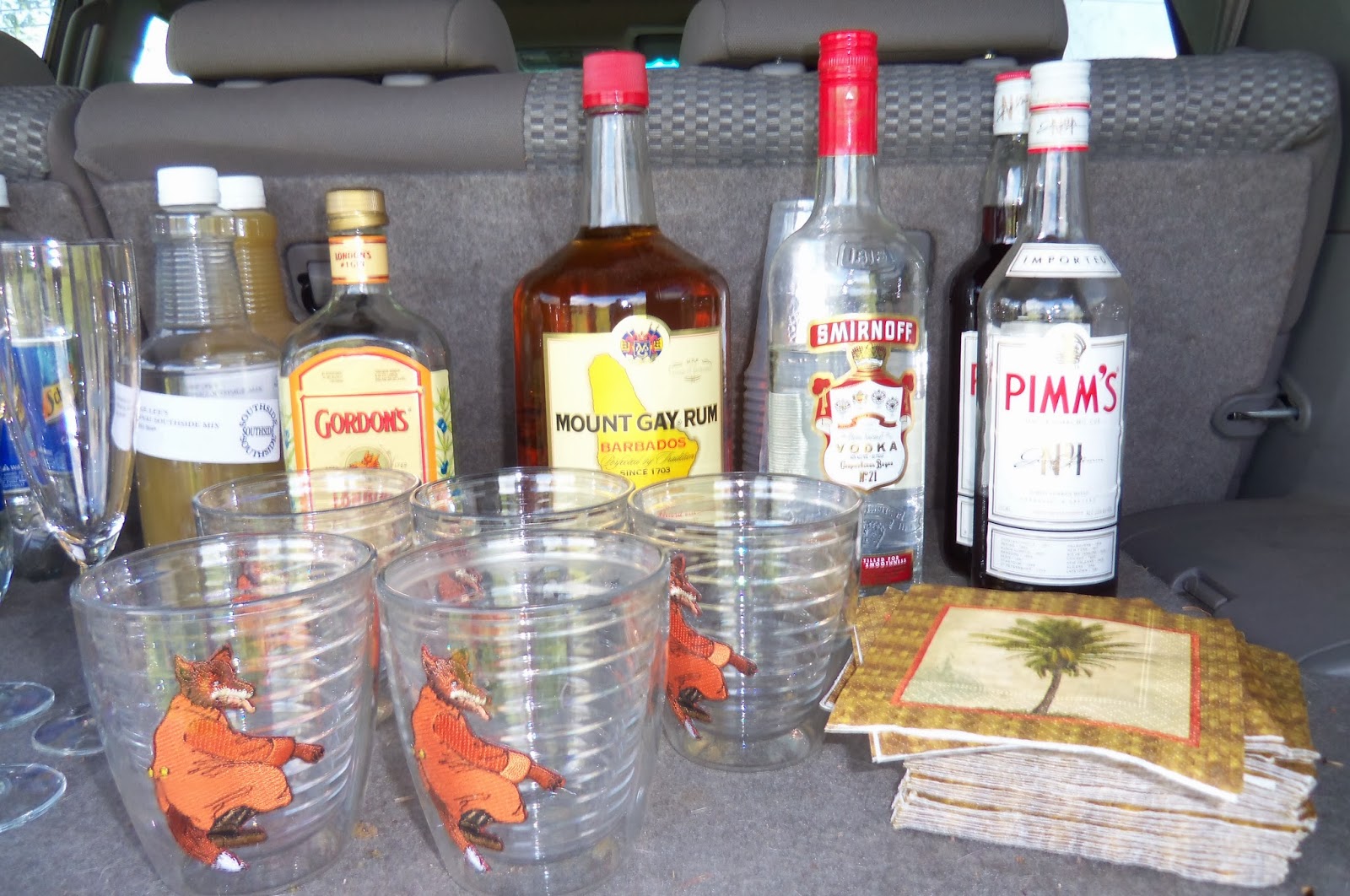
Example of a small bar set up for a tailgate
It's very easy to get caught up in the variety of liquors available. And perhaps even easier to simply buy the most expensive bottles you can find, expecting that these choices will provide you with the best stocked bar. For me, there is a much simpler solution, find the best bottle for your money and base the bar around these choices. These work well in most straight up drinks, as well as mixed drinks without feeling like you've wasted your money hiding expensive alcohol under the taste of mixers.
Bourbon Whiskey- Either Jim Beam or Jack Daniels (yes, this correctly known as Tennessee Whiskey) are excellent choices.
Scotch Whisky - Dewar's or J&B are both excellent choices for blended Scotch.
Vodka - Smirnoff is my go to brand, but Gilby's or Gordon's will also do nicely.
Gin - Gordon's would be my first choice or Gilby's for those who are not partial to Gordon's.
Rum - Mt. Gay is the perfect choice, though if you are partial to a Dark and Stormy, then you will need Goslings Rum, or if Planter's Punch is your choice, then you will need Myers's Rum. I should add that if you like a bit of rum in your eggnog at Christmas, you should probably not use Mt. Gay as it isn't quite suited to that purpose.
Mixers - Club Soda, Ginger Ale and Tonic Water are really all you need to keep on hand. If you buy them in the one liter bottle size, you will find that they lose their fizz even if you never open the bottles. Your best bet to keep these on hand for guests is to buy them in the small glass bottles by the six pack. These work well for individual servings, with little waste and they keep their fizz unopened much longer than the plastic bottles. If you are throwing a party, get you should buy them in the one liter size.
Accessories - There are a number of tools you should keep handy near the bar. These will make serving drinks much simpler and prevent your needing to run about trying to find the things you need to make a drink. These include a bottle opener, a cork screw (the simple "waiter style" really do work best), a cocktail shaker, a cutting board for limes and lemons, an ice bucket, ice tongs, a jigger (the best sort are "double ended" with a one ounce measure on one end and a one and a half ounce measure on the other end, and a strainer (useful for keeping ice out of your martini).
While this list may seem rather basic, that is its intent. Even for those who don't drink much, if at all, this would cover most guests needs, should you wish to serve alcohol. For those who do drink, this list will help to cover the drink requests beyond your usual tipple.
Now, if you have a personal favorite for yourself or a family member, then these are easily added to the list. These is still room for your favorite single malt scotch, a bottle of irish whisky, or a bottle of small batch bourbon.
A few very English additions can be made to the bar for those whose tastes lean in that direction. These are as follows:
Cherry Brandy - Drink this either straight or mixed with scotch to create a beverage called Chisky. Yes, I know that sounds like an odd combination, but try it some time and you will be pleasantly surprised. Perhaps the best available is Grant's Cherry Morella Brandy. It was mentioned in the Pickwick Papers and was a favorite of Queen Victoria. In simple terms the best. But damned difficult to find this side of the Atlantic, so stock up when you can if you fancy this spirit.
Sloe Gin - The only choice here is Plymouth Sloe Gin from England. A wonderful winter and early Spring drink with beautiful dark fruit flavors atop the gin base. Avoid the American imposters as they have none of the traditional ingredients.
Pimm's - It is hard to imagine summer without this classic British beverage. American's tend to mix it with ginger ale, creating something known as Pimm's Ginger. If you can find real English Lemonade, you will be able to make a proper Pimm's Cup. Those poncy French lemonades you sometimes find at the grocers will do in a pinch of you can't find British lemonade.
King's Ginger - Only recently available in America, if you enjoy the taste of ginger, this is a must!
By keeping your basic bar "basic" you have room to personalize your bar to your own tastes, while at the same time providing a variety of choices for your guests.
All Rights Reserved.

