Friday, January 3, 2014

Annapolis Roads on Chesapeake Bay 1925-1934 - Part 1: The Development

This is not a complete piece by any means, but something I felt I needed to post now seeing the demise of the last of the historic community. For those who cling to what they see as an Olmstead Brothers designed community, you will find that it is not what you imagine and once had the imagination for much more. With the closure of the Annapolis Roads Golf Course on September 29, 2013, the last remnant of this grand vision vanishes from history leaving just its road layout as the last remaining historic feature.

So we begin with part one of the requiem...

Annapolis Roads on Chesapeake Bay

1925 – 1934

The Development


Paul Armstrong purchased the 341-acre Belmont Farm on November 13, 1907, possibly using it as a country retreat.i Armstrong was a playwright and screenwriter and spent some of his time in New York City. He died in 1915 and his widow Rella Abell Armstrong became trustee of his estate for their three daughters.ii

About 10 years after his death, Mrs. Armstrong decided to develop the property. In 1925, she approached the Olmsted Brothers, of Brookline, Massachusetts to plan for the development of her property as a hotel resort.iii This firm was responsible for the planning of Roland Park in Baltimore and Wardour in Annapolis, as well as many other public and private landscape plans throughout the country. Work on the project was assigned to Harvard educated Percival Gallagher.

On December 22, 1925 Armstrong sold the property to The Armstrong Company, which she set up to handle the development and of which she was president.iv By January 1926, J. Revell Carr had started survey work.v Gallagher felt that “to fix upon the location of the hotel [was] of the first importance as it [would] determine the location of the road as it leaves the building.”vi This road was to be the main road into the development, now known as Carrolton Road. The bank from which Armstrong wanted to borrow the money for the project was positive about the project, but they regarded “the golf course as of essential importance in the consideration of the income returns.”vii

            Gallagher felt that was “unwise to give over so much of the rough wooded land, adjacent to Lake Ogleton, for residence lot purposes, because of the extreme roughness of the topography making it not only a costly operation to carry roads through it, but doubtful whether much of the land could be utilized for house sites without destruction of a great deal of the natural conditions.”viii He proposed “instead of extending the residence lot development continuously along the southerly edge of the property following the edge of Lake Ogleton around to the hotel, that the lot development follow around to the northeast along the main road to the hotel, with a belt of lots along the “Railroad” way.ix This “Railroad” way was the former right-of-way of the Bay Ridge Railroad. Gallagher also planned for “a well defined entrance to the property on the “Railroad” way as one approaches it from Annapolis.”x He felt the “need to mark the principal entrance by some spaciousness other than what the ordinary street demands and the suggestion of a small village square [seemed] appropriate.xi It was his belief that he could “secure, in the design of your property, a distinctive character which [would] enhance rather the natural charm of the property.xii Gallagher “was very much impressed with the wooded ravines and slopes, especially at the Point where the hotel [was] to be located and it [seemed] to [him] that, in conjunction with the dignified and refined character of the architecture proposed, the old trees composing the woods that extend down the several ravines, would make most interesting pleasure grounds and of such extent as to give a satisfying environment to the hotel itself. These wooded slopes very much [enhanced] glimpses of the Chesapeake and of Lake Ogleton and to [him] appealed much more strongly than an unbroken sweeping view of the Chesapeake alone.xiii


                Armstrong had suggested to Gallagher that a bridle path be built down the center of the main road to the hotel “ with two one-way” roads on either side, [each being] 15 feet wide.xiv Gallagher rejected this concept and instead suggested a “50-foot street between the property lines, with [a] 18-foot graveled way in the center and space for sidewalks on either side. As the place [grew] it [would] be found necessary [he was] sure to widen the 18-foot graveled space to at least 28 feet in order to permit parking in front of each lot with space for two lines of moving vehicles.”xv He further suggested that the bridle path be placed “along the edge of the golf course just back from the tier of lots south of the main road.”xvi A “large turning space” space was planned for “just outside the gates to the hotel grounds proper” which would “serve as a turn for cars not wishing to go to the hotel.xvii “The turn court” was also planned to be “enlarged” and “graveled over a large part of its area to serve as parking spaces.”xviii

              It is at this point that the first signs of an undercapitalized project began to surface. During a meeting on June 12th with Gallagher and Charles Banks, architect of the planned golf course, Armstrong explained “that the hotel [was] her prime feature, yet she [wanted] to lift the burden of the cost by the sale of land of the cottage lots.”xix

              Armstrong also sought out the landscaping advice of Gallagher. She “planned [to] put cedars behind the [entrance gate] wall and a row of cedars up the main road to the row of big trees.”xx She also planned to plant dwarf evergreens in front of this wall and a “privet hedge from the end of the gates to the woods one side and the fence line on the other.”xxi Gallagher preferred “grouping the cedars with reference to the proposed lotting divisions and not making a continuous line on either side of the road.”xxii He suggested that the cedars be “grouped more thickly on the higher ground and… planted just at the proposed property line.”xxiii Deciduous trees were to be “planted between the curb line and the sidewalk line, not in uniform distance nor in a straight line but roughly alternating with the groups of cedars.”xxiv The purpose of this was to “keep the natural atmosphere of the place which would be lost with a solid row of planting one kind of tree.”xxv Large emphasis was placed upon the use of the native Eastern Red Cedar (Juniperus Virginiana) to line sections of the Carrolton Road as well as to be placed directly behind the entrance gates.xxvi California Privet was to be used as envisioned by Armstrong and native Red Oak (Quercus Rubra) would be used near the entrance gates along Carrolton Road to line parts of that section of road as well as to fill a “grove” to the immediate right just inside of the entrance gates.xxvii Additional used of native Sugar Maple (Acer Saccarhum), native American Sycamore (Platanus Occidentalis), native Pin Oak (Quercus Palustris) and native American Elm (Ulmus Americana) would be used along the Carrolton Road, though in lesser numbers then the above species.

                  The first general plan of the property was completed September 12th and was enthusiastically received by Armstrong.xxviii She thought it was “ a beautiful layout” and that it gave “such a wonderful free sweep.”xxix With this plan the property, 163.9 acres were allotted to golf, 87.8 acres were allotted to housing lots, 18.1 acres were allotted to roads and 36.4 acres were allotted for the hotel grounds. It established a clearly defined area for a golf course in the center of the property and left the most desirable sites for homes along the outer edges of the property.

                   By May 1927, the Munsey Trust Company was contracted to act as trustee for the property and Morgan Wickersham & Company was contracted to be the sales agency.xxx The first advertisement appeared in The Washington Post on May 29th and touted the planned 18-hole golf course, country and yacht club, year round hotel, tennis courts and bathing.xxxi Almost 4 weeks later sales of lots had already been reported with plans for the occupancy of several homes by the following season.xxxii

Armstrong was quite concerned about selling the cottage lots and concluded that the lots “must not average above 1/3 acre in size otherwise the price [would] be too high to meet the competition of other developments,”xxxiii each lot averaging one–third of an acre. Bay waterfront would be sold for 20 to 22 cents per square foot (approximately $3,500 per lot), the Otter Lake section from 14 to 18 cents per square foot (approximately $2,500 per lot), and lots on the roads would sell for 10 to 12 cents per square foot (approximately $1,600 per lot).xxxiv Her financial situation must have been rather tight because at this time she requested a delay of payment to Olmsted Brothers “for a short period of time” so she could continue her improvements to the property as the sales of cottage lots began.xxxv Clearly undercapitalized, she was relying on cottage lot sales not just to finance the construction of the hotel, but also the costs of planning of the property.

              By early June, Gallagher had prepared plans for the re-lotting of Section B of the property, now bounded by Claibourne and Carrolton Roads, increasing the number of lots from 29 to 32.xxxvi This re-lotting did not affect the small court enclosing a small park named “Washington Square.” He also suggested using lots 18 through 22 along Carrolton Road on the Golf Course side, which was the site of the former farmhouse on the property, as the best location for the golf house. Contrary to Gallagher’s opinion about retaining the large lot size along Lake Ogleton, Armstrong, with Wickersham’s advice, preferred to have an average 1/3 acre lot size to keep the price down, but still allowing the prospect to buy several lots and combine them if a larger lot was desired.xxxvii Also at this time, Armstrong provided Gallagher with the names for the roads on the property. They were named after individuals important in Maryland’s colonial history in keeping with the colonial revival style of the development.xxxviii

Study for Relotting
(Courtesy of the United States Department of the Interior, National Park Service, Frederick Law Olmsted National Historic Site)

                The re-lotting of the entire site was completed by early August, producing 333 lots with an average size on .38 acres.xxxix Carr began to prepare the large-scale selling plats for Section C (that on Otter Lake) and Section D (the Lands End area on Lake Ogleton) in November.xl During the re-lotting for these sections and Section B, some of the lots were further changed in size, but the biggest change was the elimination of “Washington Square” for cottage lots, though this did not change the number of lots in that section. The “Village Green,” along with Lafayette and Cevera Lanes running roughly parallel with Bay Ridge Road and connecting Carrolton and Ogleton Roads, still remained as part of the General plan of the development.

                    On November 22, 1927, with sales and development not progressing as hoped, Armstrong contracted with the Munsey Trust Company to take over sales and development of Annapolis Roads for five years.xli The Armstrong Company then signed a contract with the Annapolis Roads Company and on December 2, 1927 transferred the property to the Annapolis Roads Company to facilitate the development and financing of the project.xlii The Annapolis Roads Company mortgaged the property for $250,000 financed by The Equitable Company.xliii
The Munsey Trust Company began development of the property in earnest, erecting the “tavern” or golf clubhouse, constructing the golf course, and erecting the clubhouse for “The Beach and Tennis Club.”xliv

With the change of control of the development of the property, Olmsted Brothers wished to settle their accounts with Armstrong and the Armstrong Company.xlv It would be some time before the Olmsted Brothers would begin to see payment for Gallagher’s work at Annapolis Roads. The first check from Armstrong to Olmsted Brothers would not arrive until September 16, 1929.xlvi

               Though it is not clear under what circumstances it occurred, it appears that Banks and the Munsey Trust Company won out in the battle over cottage lots or the golf course. A number of lots were eliminated from the general plan published by the Munsey Trust Company, which was now acting as Developer and Sales Agent, at the main entrance to the development along with the “Village Green” and Lafayette and Cevera Lanes.xlvii This reduced the property to 250 lots, of which only 15 would be sold by the end of September 1929.xlviii

Plans for sales were in full swing in the spring of 1928 with several advertisements appearing in The Washington Post. The golf course, landing pier, roadways, electricity, telephones, automatic water system, tavern and bathhouses were all under construction.xlix Though sales had been reported in July 1927, it appears these sales were only deposits on lots, since the first lots in Section D were not platted until July 1927 and filed in September 1928 and lots in Section C were not platted until August 1927 and filed in May 1928. The first deed of sale was completed September 1928.l

Like most planned developments of the 1920s, The Annapolis Roads Company was concerned about maintaining property values through restrictive covenants. Even the advertising spoke of sales to “a restricted class and limited number of people.li The houses were to be of a strictly residential nature. There were to be no apartments, flats or dwelling for more than one family and every dwelling was to be completely detached. All houses erected or altered in any way were to have their plans submitted to the Annapolis Roads Company and approved in writing. The Annapolis Roads Company had the right at any time to trim trees, shrubbery, lawns or underbrush on any property in order to improve or preserve the views of land and water and to maintain the general landscaping plan for the best interests of the entire property. Half of the actual cost of upkeep of the sidewalks and roadways along and abutting each property were to be paid by the property owner, though assessments for new roadways and sidewalks were not to be made without the consent of the majority of the owners of the land affected by the improvements. These covenants were to remain in effect for twenty-five years. Once purchased any property transfers in the first fifteen years of ownership had to be approved by the Annapolis Roads Company. A final covenant prohibited Blacks and Jews from owning property or living in the development except where they were employed as domestic servants by the owner. This final covenant was to remain in effect for ninety-nine years.lii

Additional funds were needed to continue the development of the project and the lots on which the “tavern” was built as well as the “tavern itself were mortgaged for $25,000.liii Further funds were raised September 29, 1929 with the mortgage of the recently completed Beach Club for $100,000 financed again by The Equitable Company.liv Financial trouble continued, requiring The Annapolis Roads Company to mortgage the entire contents of the golf club and the beach and tennis club for just over $91,000 on May 1, 1932, financed by the Equitable Company.lv

As the five-year contract with the Munsey Trust Company came to an end, a decision was made not to renew the contract and The Armstrong Company took over management of the property.lvi In August 1932, the L.S. Scott Corporation took over sales of the development from the Munsey Trust Company.lvii By the end of 1932, Armstrong had several suits pending against her and the Annapolis Roads Company for merchandise accounts and the property was heavily mortgaged offering no chance to procure additional funds.lviii Armstrong desperately attempted to generate fund and began to sell any waterfront property she could. With most of the platted waterfront lots already sold, The Armstrong Company sold “the point lot” at the end of Carrollton Road, which had been previously reserved as a public space and a boat landing on Lake Ogleton.lix

              Finally The Annapolis Roads Company defaulted on the original mortgage and on January 22, 1934 the property was sold at auction at the courthouse door in Annapolis. The Equitable Company was the high bidder and purchased the property on May 28, 1934 for $110,000.lx The Equitable Company would retain ownership of the development until 1950 when it was sold to Club Estates, which continued development of the property platting the remainder of the property and selling off the unsold cottage lots.lxi

i Anne Arundel County Circuit Court (Land Records) [MSA CE 59-125] GW 57, pg 338.
ii James G. Gibb, “Belmont Farm, Precursor to Annapolis Roads,” The Bay Breeze (Fall 2001), pp. 4, 7.
iii James G. Gibb, “Designing Annapolis Roads, 1926-1934,” The Bay Breeze (Winter 2002), pg. 2.
iv Anne Arundel County Circuit Court (Land Records) WMB 23, pg 32. Sale price of the property was $100,000.
v Percival Gallagher to Rella Armstrong February 1926. Carr was County Surveyor for Anne Arundel County and had an office at 14 Church Circle in Annapolis.
vi Ibid.
vii Rella Armstrong to Percival Gallagher February 19, 1926
viii Percival Gallagher to Rella Armstrong March 1, 1926.
ix Ibid.
x Ibid.
xi Ibid.
xii Ibid.
xiii Ibid.
xiv Percival Gallagher to Rella Armstrong April 22, 1926
xv Ibid.
xvi Ibid.
xvii LLB to Rella Armstrong May 22, 1926
xviii Ibid.
xix Ibid.
xx Rella Armstrong to Percival Gallagher September 9, 1926
xxi Ibid
xxii LLB to Rella Armstrong September 21, 1926
xxiii Ibid.
xxiv Ibid.
xxv Ibid.
xxvi Plan 7591-26, A Planting Study for Entrance Road; Scale 1"= 50'
xxvii Plan 7591-26, A Planting Study for Entrance Road; Scale 1"= 50'
xxviii Rella Armstrong to Percival Gallagher September 26, 1926
xxix Ibid.
xxx Rella Armstrong to Percival Gallagher May 24, 1927
xxxi The Washington Post, May 29, 1927 pg 27.
xxxii The Washington Post, July 31, 1927
xxxiii Ibid.
xxxiv Ibid.
xxxv Ibid.
xxxvi LLB to Rella Armstrong June 6, 1927
xxxvii Rella Armstrong to Percival Gallagher June 1927
xxxviii Ibid.
xxxix LLB to Rella Armstrong August 3, 1927
xl Rella Armstrong to Percival Gallagher November 9, 1927
xli CRP to Rella Armstrong January 23, 1928. Rella Armstrong to Percival Gallagher February 10, 1928; Agreement between Armstrong Company, the Munsey Trust Company and the Annapolis Roads Company April 1929.
xlii Anne Arundel County Circuit Court (Land Records) FSR 24, pg 264.
xliii Anne Arundel County Circuit Court (Land Records) FSR 22, pg 387.
xliv Agreement between Armstrong Company, the Munsey Trust Company and the Annapolis Roads Company April 1929.
xlv CRP to Rella Armstrong January 23, 1928. The total bill from the Olmsted Brother was $3285.36 for work done on the Annapolis Roads Project.
xlvi Arthur Bishop to Olmsted Brothers Jasnuary 17, 1930
xlvii CRP to Rella Armstrong January 23, 1927. Rella Armstrong to Percival Gallagher February 10, 1928. The Munsey Trust general plan is a undated plan found in the Olmsted Associates Job File 7591, Folder 1; Agreement between Armstrong Company, the Munsey Trust Company and the Annapolis Roads Company April 1929.
xlviii Rella Armstrong to Arthur Bishop September 23, 1929
xlix The Washington Post, May 11, 1928 pg 4
l Anne Arundel County Circuit Court (Land Records) FSR 41, pg 12.
li The Washington Post, May 11, 1928 pg 4
lii Anne Arundel County Circuit Court (Land Records) FSR 41, pg 12.
liii Agreement between Armstrong Company, the Munsey Trust Company and the Annapolis Roads Company April 1929.
liv Anne Arundel County Circuit Court (Land Records) FSR 45, pg 40.
lv Anne Arundel County Circuit Court (Land Records) FSR 101, pg 465.
lvi Arthur A. Bishop & Company to Olmsted Brothers, June 20, 1932.
lvii The Washington Post, August 14, 1932, pg R2
lviii Arthur A. Bishop & Company to Olmsted Brothers, December 16, 1932.
lix Anne Arundel County Circuit Court (Land Records) FSR 104, pg 148.
lx Anne Arundel County Circuit Court (Land Records) WMB 128, pg 523.
lxi Anne Arundel County Circuit Court (Land Records) [MSA CE 59-920] JHH 576, pg 559.

All Rights Reserved.

Sunday, December 29, 2013

Building the Bar...

It's been some time since my last post, but with the end of another year and the number of parties which occur at this time of the year, I thought it was time to look at the bar. Whether it is stuffed in a cupboard out of sight or prominently displayed in a room, the contents of a bar are far more important than how and where it is displayed, if at all.

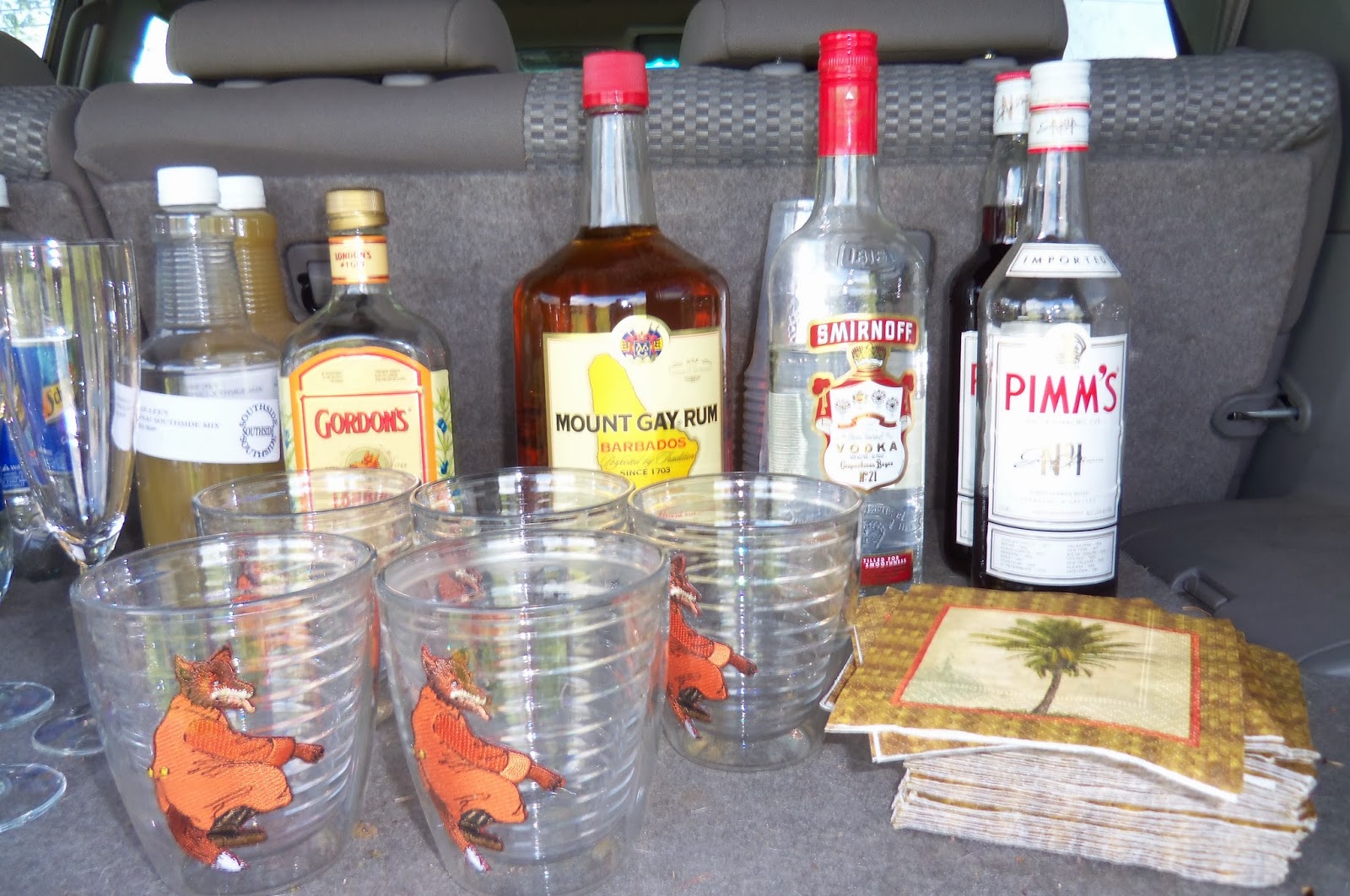
Example of a small bar set up for a tailgate

It's very easy to get caught up in the variety of liquors available. And perhaps even easier to simply buy the most expensive bottles you can find, expecting that these choices will provide you with the best stocked bar. For me, there is a much simpler solution, find the best bottle for your money and base the bar around these choices. These work well in most straight up drinks, as well as mixed drinks without feeling like you've wasted your money hiding expensive alcohol under the taste of mixers.

Bourbon Whiskey- Either Jim Beam or Jack Daniels (yes, this correctly known as Tennessee Whiskey) are excellent choices.

Scotch Whisky - Dewar's or J&B are both excellent choices for blended Scotch.

Vodka - Smirnoff is my go to brand, but Gilby's or Gordon's will also do nicely.

Gin - Gordon's would be my first choice or Gilby's for those who are not partial to Gordon's.

Rum - Mt. Gay is the perfect choice, though if you are partial to a Dark and Stormy, then you will need Goslings Rum, or if Planter's Punch is your choice, then you will need Myers's Rum. I should add that if you like a bit of rum in your eggnog at Christmas, you should probably not use Mt. Gay as it isn't quite suited to that purpose.

Mixers - Club Soda, Ginger Ale and Tonic Water are really all you need to keep on hand. If you buy them in the one liter bottle size, you will find that they lose their fizz even if you never open the bottles. Your best bet to keep these on hand for guests is to buy them in the small glass bottles by the six pack. These work well for individual servings, with little waste and they keep their fizz unopened much longer than the plastic bottles. If you are throwing a party, get you should buy them in the one liter size.

Accessories - There are a number of tools you should keep handy near the bar. These will make serving drinks much simpler and prevent your needing to run about trying to find the things you need to make a drink. These include a bottle opener, a cork screw (the simple "waiter style" really do work best), a cocktail shaker, a cutting board for limes and lemons,  an ice bucket, ice tongs, a jigger (the best sort are "double ended" with a one ounce measure on one end and a one and a half ounce measure on the other end, and a strainer (useful for keeping ice out of your martini).

While this list may seem rather basic, that is its intent. Even for those who don't drink much, if at all, this would cover most guests needs, should you wish to serve alcohol. For those who do drink, this list will help to cover the drink requests beyond your usual tipple.

Now, if you have a personal favorite for yourself or a family member, then these are easily added to the list. These is still room for your favorite single malt scotch, a bottle of irish whisky, or a bottle of small batch bourbon.

A few very English additions can be made to the bar for those whose tastes lean in that direction. These are as follows:

Cherry Brandy - Drink this either straight or mixed with scotch to create a beverage called Chisky. Yes, I know that sounds like an odd combination, but try it some time and you will be pleasantly surprised. Perhaps the best available is Grant's Cherry Morella Brandy. It was mentioned in the Pickwick Papers and was a favorite of Queen Victoria. In simple terms the best. But damned difficult to find this side of the Atlantic, so stock up when you can if you fancy this spirit.

Sloe Gin - The only choice here is Plymouth Sloe Gin from England. A wonderful winter and early Spring drink with beautiful dark fruit flavors atop the gin base. Avoid the American imposters as they have none of the traditional ingredients.

Pimm's - It is hard to imagine summer without this classic British beverage. American's tend to mix it with ginger ale, creating something known as Pimm's Ginger. If you can find real English Lemonade, you will be able to make a proper Pimm's Cup. Those poncy French lemonades you sometimes find at the grocers will do in a pinch of you can't find British lemonade.

King's Ginger - Only recently available in America, if you enjoy the taste of ginger, this is a must!

By keeping your basic bar "basic" you have room to personalize your bar to your own tastes, while at the same time providing a variety of choices for your guests.

All Rights Reserved.

Monday, May 6, 2013

What's in Your Cup?.... Why Not Try a Pimm's Cup!

The other weekend at the Maryland Hunt Cup I was once again reminded of that classic British summer drink, Pimm's Cup. It's appearance at a picnic or party is one of the many heralds of summer. While there is no rule which states that I cannot enjoy a Pimm's Cup at other times of the year, there is something uniquely satisfying about enjoying foods and beverages in a seasonal rotation. We are sad to say goodbye at the end of that season and eagerly await the day the following year while it makes its first appearance.


I've been drinking Pimm's cup for over 20 year, first being introduced to it at the Virginia Gold Cup Races which are held the first Saturday in May. While many others at the picnic were enjoying their Mint Juleps, it was in the Pimm's Cup that I found my thirst quenched.

In 1823, James Pimm created a gin based "house cup" flavored with liqueurs and fruit extract as an accompaniment to oysters at his famous central London Oyster Bar. This later became known as Pimm's No. 1 Cup. By 1851 he created a scotch based No. 2 Cup and brandy based No. 3 Cup. After World War II, Pimm's created a rum based No. 4 Cup, and the 1960's brought the rye based No. 5 Cup and vodka based No. 6 Cup. Hard times in the 1970s brought an end to most of these other Cups, the No. 6 Cup being produced in very small quantities today and the No. 3 Cup is now infused with spices and orange peel and marketed as Pimm's Winter Cup.

If an American takes a look at the instructions on how to make a Pimm's, they will see that either a lemon-lime soda or ginger ale is recommended. Unfortunately not all things translate well between the Queen's English and American English. A quick look at the official Pimm's website will show the "Pimm's Original" is made using lemonade and the "Pimm's Ginger" is made using ginger ale. These are really two very different tasting drinks, the ginger version being slightly sweeter than the lemonade version.

So what do the English mean by lemonade in the Pimm's Original? Well, I decided to use R. White's lemonade, a brand nearly as old as Pimm's itself, being made since 1845. Perhaps the best way to explain this lemonade to someone who has never tried it is to compare it to those expensive French lemonades you sometimes see at the grocers in the large liter glass bottles. It is dry and carbonated, which works well to balance the natural sweetness of the Pimm's.

So if you are looking for a distinctly British beverage to enjoy a beautiful Spring or Summer afternoon, think about trying a Pimm's. I know that every time I enjoy a Pimm's at the end of a long Winter, I know that Spring has fianlly arrived and I look forward to many more chances to enjoy this classic drink.


Monday, April 22, 2013

The Greatest Timber Race... The Maryland Hunt Cup

When last Saturday in April arrives in Baltimore, the focus of a large part of Baltimore turns to the same place it has since the days of their grandparents and even great grandparents, the Worthington Valley. It's time for the Maryland Hunt Cup, a true test of a horses and riders endurance.

This isn't your average horse race. The horses, averaging 10-13 years old race over 22 fences, 4 board and 18 rail, ranging in height from 2'11" at the water jump to 4'10" at the number 16 fence. And that is it, one race! It is an entire afternoon spent picnicking and tailgating in anticipation of that single race. The only vendors present are selling the race program and race caps and t-shirts. There is no other commercial activity and no commercial advertising present anywhere. How many other horse racing events are only based around one race? And how many major sporting events are still void of corporate sponsorships? I can't think of anywhere else I'd rather be on the last Saturday in April.


13th Fence at the 2012 Maryland Hunt Cup

The Maryland Hunt Cup began in 1894 when the members of the Elkridge Hunt challenged members of Green Spring Valley Hunt to a timber race on Dr. William Lee's property near Stevenson Station in the Green Spring Valley and heading east finishing near George Brown's race track at Brooklandwood, a distance of 4 miles. The first race was limited to members of those two clubs, but the next year the race was opened to members of any fox hunt in Maryland. In 1903, members from recognized hunts throughout the United States and Canada were invited to participate.

In 1895 the race began at Hampton Gate on Dulaney Valley Road, a mile north of Towson, and ran over a circular course of about 4 1/8 miles. The following year the race returned to the Green spring Valley, starting at Brooklandwood and running a distance of a little less than 5 miles. It remained in that area one last time in 1897, starting in a field directly north of Brooklandville Station on the east side of Falls Road.

In 1898 the race moved near Cockeysville, starting and ending at Gerar, the country home of E. Gittings Merryman and the following year to “Long Green,” the country seat of W.S.G. Williams. The house at Gerar was demolished by 1962 to make way for Marriott's Hunt Valley Inn, with the remainder of the property becoming part of the Hunt Valley Industrial Park. Long Green would become part of the Deford/Boordy Vineyard Estate.

The race returned to the Green Spring Valley in 1900 and 1901 before moving to R.M. Dennison’s farm, Salona in Timonium in 1902. Then in 1903, the race started 1/4 mile north of Towson, directly east of York Road, and finishing at Hampton. In 1904, the Hunt cup returned for one last run in the Green Spring Valley, site of its birth ten years earlier, where it remained through 1914, running over a number of owners properties.

In 1915, the Hunt Cup left the Green Spring Valley for good, never to return. That year it was run for the first time in the Worthington Valley, starting and finishing at Merberne Manor Farm, the home of G. Bernard Fenwick, where it remained through 1918. Since the Fenwick Farm was entirely fenced in wire, the race committee had to build panel fences in order to run the race.

With the Fenwick Farm being planted in corn in 1919, the race moved back to Hampton in Dulaney Valley for two years before moving to Five Farms, country home of Stuart Oliver, for the 1921 race, the last race to be run outside Worthington Valley.


Finish Line at the 2012 Maryland Hunt Cup

In 1922, the Hunt Cup returned to the Worthington Valley and Snow Hill, the home of Charles L.A. Heiser, and the present Hunt Cup course. Since that time, the course has remained fixed, with only the names of the property owners changing over the years.

The present course was originally laid out by G. Bernard Fenwick and Thomas Disney and has stood the test of time, still providing perhaps the most challenging and well known steeplechase course on either side of the Atlantic. It is this race, and this race alone which receives regular mention in British Steeplechase racing circuits and for good reason.

There are three different parking options for spectators and everyone has their favorite vantage point, from any of the 22 jumps, to the hillside overlooking the course or the final dash for the finish. If you plan things well, you can even see multiple jumps and the finish line up close. And while this race is clearly the dressiest of all the Maryland timber races, spectators for this races, like all the races, are well advised to first dress for the weather and then to dress for fashion.

So the last Saturday in April each year, I make the trek to Worthington Valley to join my friends and many strangers and watch one of the greatest spectacles in Steeplechase racing. I wouldn't have it any other way!

All Rights Reserved.

Monday, April 15, 2013

Since 1898... It's time for the Grand National

When the second half of April arrives in Baltimore, there is a part of the city whose focus is not on the American pastime of baseball, but rather an earlier and much deeper and British connection to the turf and horse racing. 

I must say, the Grand National is one of my favorite races. For the money, a general admission pass will give you three great races viewed from a hillside, and don't forget your picnic basket and waterproof picnic blanket. This is a hard value to beat when it comes to racing and the view of the course.


2012 Grand National

The Grand National began in 1898 when several young men who wanted to compete in the Maryland Hunt Cup, but were too young to enter, established this race. All the riders were under 16 and rode ponies, except for one horse. The race was run over 2 1/2 miles near Chattolanee Hotel near the Golf Course of the present Green Spring Valley Club. As the riders became older, the age limit was raised so they could continue to participate. 

The race continued to be run over various courses in the Green Spring Valley through 1917, with the lengthening to 3 miles in 1906 and averaging 15 to 20 fences plus ditches and even streams. 

With a brief hiatus due to World War I, the race resumed in 1920 at Five Farms, the estate of Stuart Oliver, until the property was sold in Baltimore Country Club for their new golf course. 

In 1925 the Grand National moved to Brooklandwood, the estate of Captain Isaac Emerson, now the site of St. Paul's School at the corner of Falls Road and Green Spring Valley Road, where it remained through 1934. This 3 mile course consisted of 15 fences averaging 4'1" high and also had a water jump. It was in 1934 the for the first time a second race was added to the card for the Grand National, the Churchville Cup which was run from 1934 until1939.


2012 Grand National

Another move was in store for the race, this time to Hereford Farms, the William R. Wittingham estate at the corner of York road and Piney Hill Road, just south of Hereford, where the race was run from 1935 until 1942, when World War II again interrupted racing. The Hereford Farms course was 1 1/2 miles long run twice around and had 16 fences to be negotiated. It was also here that the first subscriber fee was introduced to watch the races. In 1940, the Foxhunter's Challenge Cup was added to the days card, as a replacement for the Churchville Cup, and was run by members of recognized hunts or United States Army officers over a five mile course.

With the war over, the Grand National was once again resumed in 1946, this time in its final and current location, Western Run Valley and the farms of the Griswold and Fenwick families. The 3 mile course consisted of 18 fences, 2 board and 16 rail, ranging from 3'9" to 4'2" high.

In 1949 the Western Run Plate was added to the card and then in 1965 the Benjamin H. Murray Memorial was added, giving the day the three races it retains to this day. As a side note, the current Western Run Plate is a revival of that original race begun in 1949.

While the Grand National is often compared to the Maryland Hunt Cup, there are distinct differences, the Grand National is a shorter race, resulting in faster racing. The Hunt Cup is the real test of a horses endurance.

So this Saturday, like every second to last Saturday in April, I make the trek to Western Run Valley to join my friends and many strangers to watch some amazing athletes, both horses and jockeys, compete in one of the most exciting sports, in some of the most beautiful settings. I wouldn't have it any other way!

All Rights Reserved.

Monday, April 8, 2013

Return to Monkton... The My Lady's Manor Races

This Saturday is the first of the "Big Three" Maryland Races, the My Lady's Manor Races. Just down the road from the Elkridge-Harford Point-to-Point held last weekend, but with a greater amount of advertising, which attracts a much wider audience. You will find many people here who have never watched a race before, and quite a few who probably never even see the horses run while they are at the races.

The My Lady's Manor Race was first run in 1900 on the farm of Mrs. Estelle H. Pearce, and after a brief hiatus, was established as an annual event in 1909 over about 3 1/2 miles. In 1922, the John Rush Streett Memorial was added to the Manor Race card. And even in the lean years of the Great Depresssion, the Manor Races nevertheless flourished, with as many as four races on the card in the mid 1930s. The main race was run over about 3 miles with 16 timber fences, a combination of stacked, board and rail.


2012 My Lady's Manor Races

For 69 years  the race was run over a course on the Secor, Pearce, Riggs and Warfield properties in Monkton, Maryland near the intersection of Monkton and Markoe Roads. Then in 1978, facing the presure of development, the race moved to its current location adjacent to the Elkridge-Harford Hunt Club and Ladew Gardens. Even in this quiet part of the state, new houses have been built where famous race horses once battled it out for the finish line of the old course.

All three races on the card today at the Manor Races are run over timber on the 3 mile course of 16 timber fences. The fences on the course are set at about 3 foot 7 inches, which are the lowest fences of the big three races in Maryland.

This is something else which really sets Maryland racing apart from other places in America. Maryland is known for timber racing. They jump a combination of stacked, board and rail fences, all very hard and unforgiving. Those soft brush fences which are seen elsewhere are not found in Maryland and when a horse comes into contact with one, you hope for the best for both horse and rider.


2012 My Lady's Manor Races

At the Manor Races, you need to take your time to find the right spot from which to watch the races. There are quite a few different options and everyone seems to have their favorites.

The crowd here is as varied as the vantage points from which to watch the races. The tailgates/picnics and clothing are also found in a wide range of styles to suit each of the many spectators. The Manor Races probably represent the most socially diverse crowd of any of the the big three races, and passes are available next door to the course at Ladew Gardens on the day of the race for those who have not purchased theirs in advance.

And like all of the races, they are held rain or shine, so first dress for the weather and then for the occasion. While those bad days might not be for everyone, the loyal followers of the sport will always be found in Monkton the second weekend in April regardless of the weather. I know that's where I will always be!

Check out the Maryland Steeplechase Association website for more information:
http://www.marylandsteeplechase.com/main/mlm/datetime.htm

All Rights Reserved.

Wednesday, April 3, 2013

Off to Monkton... It's Time for the Elkridge-Harford Point-to-Point


So what is the difference between and Point-to-Point and a Steeplechase? Well in the UK, the Steeplechases are held over permanent courses using National Hunt rules and Point-to-Points are traditionally over ad hoc courses, though many are held on permanent courses now. But for the average spectator, there is no noticeable difference between the two types of racing, especially in the US, other than a difference in names used for them.


2012 Elkridge-Harford Point-to-Point

This weekend is the last of the local point-to-points before the "big three," the Elkridge-Harford Point-to-Point. It's held each year at Atlanta Hall Farm, in Monkton, Maryland. I've been to a number of races in Maryland and Virginia over the last 20 years and I still don't know what it is about this race which I like so much, but it's certainly a favorite. And that's saying a lot given how much I like the rest of the races in Maryland. As with last weekend at Green Spring, this is an early season race, so be prepared for cool, windy and/or wet. But also be prepared for warm sunny and slightly breezy days. Dressing in layers is hey and I always head to any of the races with my Barbour and wellies in my car in case the weather requires them.


This race is not heavily advertised. As a matter of fact, last year, even aware of where I was headed, I drove right past Pocock Road and had to turn around. Either there was no sign even mentioning the races were being held that day or I was lost in the beauty of the day and missed the sign.

But what this race lacks in advertising, it makes up for in style and racing. The course has 15 timber fences, a combination of stacked, board, rail and coop, over about 3 miles. There is not one place on the course where you can see everything, so you have to pick your spot on experience and the sort of racing day you wish to enjoy.


2012 Elkridge-Harford Point-to-Point

I should also note, that tailgating at both Green Spring and Elkridge-Harford are very casual informal affairs. That isn't to say they are pedestrian, just not over the top. Think classic, old fashioned tailgating.

And here at the Elkridge-Harford Point-to-Point, the vast majority of those in attendance, as at Green Spring, are either closely connecting with the hunt or racing, or they are fairly serious followers of the sport.

It might seem like, given the rather close distance between the Green Spring and Elkridge-Harford courses, that you'd see many of the same horses, but that is not the case. With so many races taking place this time of the year in Maryland, Pennsylvania and Virginia, very few in fact have come here directly from Green Spring. And for those who are looking to check out this years talent before they hit the "Big Three," this is another great chance to get a look before the really serious racing begins.

So pack a picnic, and bring your field glasses to Monkton this Saturday for some more amazing timber racing in Maryland!

All Rights Reserved.